
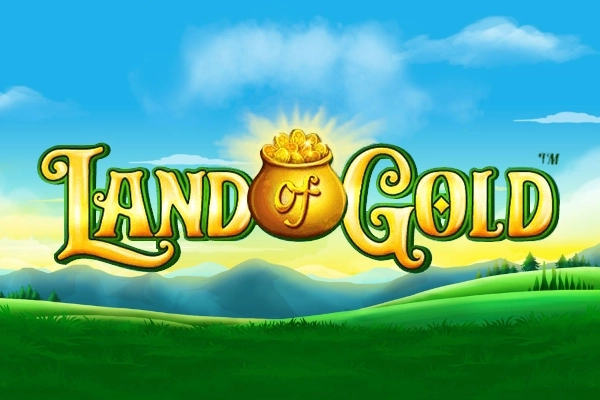
Land of Gold slot: a progressive jackpot wrapped in Irish scenery
Land of Gold pairs a shamrock-and-gold aesthetic with a progressive jackpot, according to the game data behind this site — a structure where a small share of every stake placed across a network of linked casinos feeds into a jackpot pool that keeps growing until a player hits the winning combination that triggers it. That’s a meaningfully different maths problem from a fixed-paytable slot, and it’s worth understanding before assuming this game behaves like a standard title with an Irish coat of paint.
It’s worth saying plainly, since the theme invites the opposite assumption: the shamrocks and gold coins on the reels have no bearing whatsoever on how the jackpot grows, how often it pays, or what the base game’s own RTP looks like. A progressive jackpot slot pays out the way it does because of its underlying maths and its network size, not because of what’s printed on the symbols. A player drawn in by the Irish framing and hoping it signals better luck is reading a marketing choice as a mathematical one, and the two have nothing to do with each other.
Symbols, paytable and features
Playtech, the studio behind Land of Gold, runs a business-to-business site with no consumer-facing games catalogue, and this review could not locate a dedicated information page for the title anywhere on it. That leaves the specific bonus mechanics, wild symbol behaviour and free spins trigger unconfirmed for this article, beyond the progressive jackpot structure itself and a five-reel, fixed-payline layout drawn from the site’s own game data.
What can be said generally about progressive jackpot slots in this category: the jackpot is typically won through a specific symbol combination, a bonus round, or a random trigger independent of the main paytable, and the base game usually runs a slightly lower standard RTP than a non-jackpot equivalent, because a portion of every stake is diverted into the jackpot pool rather than the base game’s own return. That’s a general pattern across the progressive jackpot category, not a confirmed fact about this specific title’s paytable split, and it’s presented here as exactly that.
That gap is the same one this review keeps running into with Playtech titles generally: a real, licensed, functioning game with none of the public documentation a player might reasonably expect before committing money to a jackpot mechanic specifically, where the stakes for getting the numbers wrong are arguably higher than on a standard-paytable slot.
The maths: an unpublished RTP, plus a jackpot with no fixed ceiling
There is no published RTP for Land of Gold’s base game from any source this review could open. On top of that baseline uncertainty, the progressive jackpot itself doesn’t have a fixed value the way a standard max win does — it grows continuously from contributed stakes until someone wins it, which means the “maximum win” question doesn’t really have a stable answer at all for this specific game.
That combination — no confirmed base RTP, and an open-ended jackpot on top of it — makes the in-client information panel more important here than on a simpler slot, since it’s the only place to find both the base RTP and any disclosure about how the jackpot contribution affects it. Once you have a base RTP figure from that panel, the house edge tool can calculate an expected-loss figure for the standard paytable, though it won’t capture the jackpot’s own separate, harder-to-model odds.
Playing Land of Gold in Ireland
The free demo is worth opening to see the paytable directly, though note that demo versions of progressive jackpot slots typically simulate the jackpot rather than connecting to the live, real-money pool — the actual jackpot value and odds only apply once you’re playing for real money at a participating casino. For real-money play, 21Bit and Wild Fortune both run wide Playtech-lineage libraries worth checking, though confirming the jackpot is actually live at a given casino matters more here than for a standard slot.
Once Ireland’s Gambling Regulation Act 2024 licensing regime takes effect, a €10 maximum stake will apply to slots of this kind. Progressive jackpots typically require a minimum stake to qualify for the top prize tier, so it’s worth checking that requirement against any future stake limit before assuming full eligibility.
A last practical point specific to progressive jackpots generally: the advertised jackpot value at any given moment is a live figure that changes with every stake placed across the network, not a fixed prize waiting to be claimed. Checking the current value in the lobby before playing gives you a much better sense of what’s actually on offer than any number this review could print, which would be stale the moment it was written down. A jackpot that has recently paid out will typically sit near its reset floor, while one that’s been building for months can run considerably higher — worth a glance before deciding whether the timing looks appealing.
Who it suits, and who should pick something else
Land of Gold suits a player drawn to the chance of a growing jackpot on top of ordinary slot play, and who’s comfortable doing without a published base RTP going in. It’s not the pick for anyone who wants full transparency before spinning — that player should look toward a title like Football Glory, where Yggdrasil states a 96.1% RTP directly, albeit without a progressive jackpot attached.
And to repeat the point plainly one more time: nothing about the Irish theme here — not the shamrocks, not the gold coins — changes a single figure behind the game. It’s decoration on top of a jackpot mechanic that would work identically under any other name.