
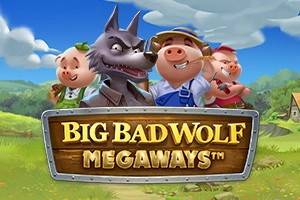
Big Bad Wolf Megaways slot: the same three houses, an updated engine
The original Big Bad Wolf was one of Quickspin’s better-remembered releases, and this Megaways version keeps the three-little-pigs framing while swapping the fixed reel structure for the variable-ways mechanic Big Time Gaming licenses across the industry. Six reels, up to 117,649 ways to win per spin, and a tumbling-reels system doing most of the actual work behind any single winning sequence, cascading through consecutive hits rather than resolving in a single static payout.
What makes this particular entry worth a longer look is something Quickspin states outright on its own page and most secondhand write-ups leave out: the game ships in three separate RTP configurations, and the casino running it picks which one goes live. That is not unusual across the industry, but few studios say so this directly on their own marketing page, and it’s exactly the kind of detail that gets lost between the studio’s disclosure and whatever a player actually reads before spinning.
Symbols, paytable and the tumble chain
Winning symbols clear after every hit, and new ones drop in to fill the gaps: a tumble, in Quickspin’s own language, and the sequence keeps going as long as fresh wins keep landing. The Piggy Wild feature layers on top of that: after two tumbles in a chain, then four, then six, Piggy symbols across reels two to five convert into wilds, which means a long tumble sequence can escalate quickly rather than fizzle out.
The bonus round, called Blowing Down the House, triggers on three Moon Bonus scatters and awards 11 free spins with a multiplier that climbs by 1x on every winning spin during the round, according to Quickspin’s own description. Players who don’t want to wait for the scatters can pay 90x their current bet for instant entry, a bonus-buy option the studio names directly on its page with no ambiguity about whether it exists.
That 90x buy-in price is worth sitting with before using it. On a €0.20 base bet, instant entry costs €18; on €1, it costs €90 in one go, with no guarantee the resulting free spins round outperforms that outlay. A bonus buy converts variance into a single upfront cost, which suits players who want to skip the grind toward a natural trigger but doesn’t change the underlying maths of the game itself, only when the cost lands in the session.
The maths: three numbers, one choice made by someone else
90%, 94% or 96% RTP, per Quickspin’s own configuration list. That is an unusually wide spread for a single game, and it changes the house edge from 10% at the bottom tier down to 4% at the top, a real difference over any meaningful number of spins, not a rounding footnote. Quickspin does not publish a maximum win multiplier or a numeric volatility rating for this title, so those two figures sit outside what can honestly be cited here, and a player relying on a review that quotes a single confident RTP for this game without naming which tier it means should treat that number with suspicion.
Because the configuration is chosen per operator, the only way to know which tier you’re actually playing is the information panel inside the game itself at whichever casino you use. Put numbers on the gap: at 100 spins an hour and a €0.20 average bet, €20 goes through the reels, and the 90% tier’s 10% edge costs about €2.00 over that hour, while the 96% tier’s 4% edge costs about €0.80 for the identical play. At €1 a spin, that same hour swings between a €10 expected cost and a €4 one, purely on which configuration happens to be running. Run the actual figures through the house edge calculator once you’ve confirmed which configuration your casino runs, rather than assuming the best case.
Playing it in Ireland
Quickspin’s catalogue, distributed through Games Global, reaches a number of the operators reviewed on this site, including casinos that run large Megaways sections. This site’s separate research into Big Time Gaming found Nomini running a Megaways category of 24 titles and Playzilla running one with 42, both checked in September 2026, the kind of shelf where a Quickspin Megaways title like this one would typically sit if it’s carried at all, though this specific game’s presence wasn’t independently reconfirmed for this review.
21Bit and Wild Fortune were also found running Megaways filters in that same research, both under Curaçao licensing rather than MGA or UKGC, worth knowing given the weaker regulatory recourse a Curaçao licence typically offers compared with the two frameworks more common elsewhere on this site’s partner list.
The demo needs no account or deposit. Real-money play currently runs under MGA or UKGC licensing for any Irish-facing casino, since the Gambling Regulatory Authority of Ireland’s own online licences are not expected before 2027. When that framework activates, a €10 maximum stake will apply to certain casino-style games under the Gambling Regulation Act 2024, and credit card deposits are already prohibited under the same law.
Who this actually suits
A player comfortable checking the actual RTP tier before staking real money will get honest value here, particularly with the bonus-buy option available for anyone who wants to skip the wait for scatters. A player who wants a single, unambiguous return figure with no configuration variable attached should look at Buffalo Blitz instead, though that Playtech title has its own disclosure gap; Bonanza, Big Time Gaming’s own Megaways original, at least commits to one fixed build rather than three.
Fans of the tumbling-reels format specifically who want a confirmed, single RTP figure attached might also compare this against Big Bass Bonanza, where Pragmatic Play’s own page states a flat 96.71% with no configuration to check first, a genuinely different proposition from a three-tier game, even if the underlying tumble-and-collect rhythm feels broadly similar on the reels.
Check the tier, then decide. That’s the entire difference between playing this game informed and playing it on faith.